Category Archives: gardening

Cutting Back Those Tiny Twinges

How do you know what yoga to practice, or, if you’re teaching, how do you know what to teach?

One answer is: read your body. Another is – read the seasons.

At the moment we’ve been doing autumn gardening – cutting back vegetation and hauling full wheelbarrows across our property to compost. This has taken a toll on my back and hips, and I’ve experienced tiny twinges of sciatic pain.

I knew that early treatment with the right sequence of poses would sort me out and so it has. I’ve taught my students the same sequence this week, as in this perfect weather, everyone has been out doing their seasonal pruning, as well.

Here are some of the poses from the sequence. Use a block held between the thighs to help internally rotate them, and to widen the sitting bones:

Tadasana – Mountain pose

Urdhva Hastasana – Tadasana with arms overhead Urdhva Hastasana

Baddha Hastasana – Tadasana with hands interlocked, arms overhead

Paschima Baddha Hastasana – Tadasana with arms folded behind back

Adho Mukha Svanasana – Down-ward facing dog pose

Uttanasana – Forward fold pose

Other helpful poses are:

Utthita Hasta Padangusthasana – Standing leg stretches

Supta Padangusthasana – Floor leg stretches Supta Padangustasana A

Share via email
Submit to StumbleUponSubmit to reddit

Do You Do Yoga as Exercise?

I hear countless conversations, read articles and hear lectures about how yoga is not just a physical exercise system. We’ve all heard them. We’ve even said such things ourselves.

Still, it’s a hard habit to break, that is, considering yoga as a way to improve fitness, flexibility, and strength. Of course, those are great benefits that asana practice (postures) can provide.

However, it’s far easier for me to go into the Yoga Shed to do an asana practice  than sit down and do pranayama (yoga breathing) and meditation. Sometimes I even have to make myself do savasana. Those practices all provide great benefits, too.

I keep grappling with the question of why I do yoga, and my best answer these days is that I want to settle my mind so that I am not reactive – an aim that’s best addressed by practising relaxation, pranayama and meditation.

I’m human.

I love exercise. Besides my asana practice, I do a program of abdominal exercises and weight training two or three times a week, all of which make me feel and look good.

Out in the garden this afternoon, armed with a mattock, I attacked a rocky clay bank to plant some bromeliads. I was glad for my strong arms, abs, and back. Any post-gardening strain was relieved by some remedial yoga poses.

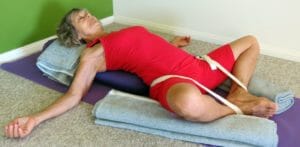
Here’s one of my favourites after-planting stretches. All you need is a bed or even the end of an upholstered sofa:

Screen Shot 2013-04-21 at 6.03.21 PM


Share via email
Submit to StumbleUponSubmit to reddit

Smell the Roses, Savour Your Good Self

PinkRoses

The Patanjali study group that I’m leading on Saturday afternoons has created some perturbation among the students, that is… stirring people up, including me.

We’re looking at the niyama, particularly the concepts of discipline and self-study.

That brought me to ponder this quote from Pema Chodran:

What we are disciplining is any form of escape from reality.

You get the idea – you can run but you cannot hide.

Today I think I revealed to myself another way that I sabotage myself which relates to my self-esteem.

For a long while, I’ve been telling myself that I’m disorganised and unproductive because my desk looks like an archeological dig which is still growing in volume. By the end of the day, I’m of the opinion that I didn’t really accomplish anything much.

So, I decided to do a reality check and keep track of what I did achieve by 6:30 pm in the evening. Here’s the list I came up with, which is pretty awesome:

  1. Mindfulness meditation (20 minutes)
  2. Asana and Pranayama practice (1.5 hours)
  3. Taught a class (1.5 hours)
  4. Called U.S. to support my sister (45 minutes)
  5. Looked after emails and social media curating (30 minutes)
  6. Planted 14 gymea lilies, with the help of other housemates, and re-potted other plants (1.5 hours)
  7. Did restorative practice (40 minutes)
  8. Washed and hung out a load of laundry
  9. Posted on my blog (45 minutes)

This might be a beneficial yoga practice for you if you are like me – a bit driven and not always stopping to smell the roses that you perhaps planted yourself :)

Gymea Lilies


Share via email
Submit to StumbleUponSubmit to reddit

A Sutra a Day: IV-29 – After Rain, Radiance

ElephantEars


Today is weather-perfection where we live on the magical mid-north coast… Mitchells Island, New South Wales.

I think you know what I mean by perfect conditions. (If you are snowed in in Vermont or Toronto, well, winter has it’s own beauty, doesn’t it?)

During the day today it’s been 24 degrees celsius, with a light breeze and mid-range humidity. Best of all, it rained last night, just enough so all the vegetation in our gardens spread its wings in the morning sunshine. When rain washes away dust and other impurities and the sun shines on that cleanliness, the droplets sparkle like diamonds.

Days like today are rare. Often we want warm, balmy weather when temperatures turn cold. Or, a cool change when summer temperatures hit the high 30′s. Do you remember that ditty?

As a rule, a man’s a fool, when it’s hot he wants it cool. When it’s cool, he wants it hot, always wanting what it’s not.

Of course, the evolved yogi is detached from such vacilations. B.K.S. Iyengar says:

When the stream of virtue pours in torrents and the consciousness is washed clean of bias, prejudice and ambition, the light of the soul dawns. This is… the fruit of the practice of yoga.

Prasankhyane ‘pyakusidasya sarvatha vivekakhyaterdharmameghah samadhih

There arises a state of mind full of clarity concerning all things at all times. It is like a rainfall of pure clarity.*

*Patanjali’s Yoga Sutras, translation and commentary by T.K.V. Desikachar.

Share via email
Submit to StumbleUponSubmit to reddit

A Sutra a Day: IV-2 – A Theory of Yoga Evolution


Zukes

Zukes

Since we hit our antipodean warm weather in early December, our vegetable garden has gone berserk.

First there were the zucchinis, hidden from view under their giant leaves, which, unattended, ballooned into green torpedo-shapes. Then came the cherry tomatoes. Well, they are still coming, and coming, and our freezer is totally packed out with them. Lately, the cucumbers have been vying with the zukes for quantity and size. Potato production was more minimal than last year but the desiree variety definitely lives up to its name.

I’d like to take credit for being a great gardener but I think the veges have evolved on their own. We prepared the soil, watered when necessary, mixed in local pony poo and seasoned with well-cooked compost.

The maturation of vegetables apparently occurs according to some intrinsic plan, all truly organic.

Fundamental change is not brought about from the outside; it must be in the material. – Satyananda Paramahamsa, Four Chapters on Freedom

Jatyantaraparinamah prakrtypurat

Positive evolution is the result of one’s innermost nature.*

*The Essence of Yoga – Reflections on the Yoga Sutras of Patanjali, translation and commentary by Bernard Bouanchaud.

Share via email
Submit to StumbleUponSubmit to reddit

A Sutra a Day: III-15 – Vegie Dreaming


Our Cabbages

I’m a city girl, born and bred. But, I always dreamed about being able to grow my own foods in the country…one day.

I’m also a sort of a know-nothing about how to do this growing produce thing. Fortunately, I’ve had some pretty switched on people around me, notably Peter Nixon and my housemate Heather.

Peter has been trying to teach me to be a patient gardener, starting in a logical sequence with the all-important rich soil. He recommended we make our own soil through the no-dig method, easy-peasy, he seemed to say. The first battle was to get rid of the enemy – kikuyu grass. We covered it with a truckload of newspaper. It took 9 months to build our decorative garden beds from all sorts of organic matter, during which time I had to be painfully patient because I just wanted to plant, plant, plant.

No, said Peter, hold your horses! You have to plant with the right season, with canopies, with healthy stock, with nutrients. Get the stages right and the garden gods will smile.

With practice on the decorative gardens, it was easier to set up the vegie garden. Same process. Who would have thought that seeing a plethora of worms emerge from our beds could bring such joy?

I’m still not very good at the ‘tough love’ part of gardening – pruning back at the end of the season and pulling up vegetables that have volunteered to be in the part of the garden where they don’t belong.

But for now, I don’t have to worry about that sort of thing. It’s harvesting time from our winter planting, and the summer vegetables haven’t even come in yet.

Krama-anyatvam parinama-anyatve hetuh

Different methods produce different changes.*

*The Essence of Yoga – Reflections on the Sutras of Patanjali, Bernard Bouanchaud.

Share via email
Submit to StumbleUponSubmit to reddit

Today (a pause from Patanjali)


I just have to tell you about what’s going on around our pretty little rural acreage. The place is jumping! It’s spring for real.

There are races going on for best soil real estate as weeds and immature vegetables vie for space. Trees we planted last autumn are raising their small arms and flexing tiny leaves as sap is rising. I’m sure if I listen very carefully, I can hear growth spurts.

The established gardens are behaving in a bolshy manner, strutting their prolific blossoms unashamedly, like China Pink here:

China Pink

But all this brouhaha is a side show to the main attraction: the birds.

We’ve had this property for 8 years and there’s never been a show like this season’s. We get eastern rosellas, galahs, king parrots, and white-headed pigeons in rotation coming to our bird feeder. Sometimes they come at the same time, and I’m surprised by their politesse, given the size and number of birds compared with the table that’s laid for them. There’s even a female king parrot who will eat out of my hand.

King


Walking through the garden, there will be a sudden swoop of a kookaburra as it leaves its sentry position on the hills hoist or gate post. In the forest behind our house, in the shrubs and thickets perch brown cuckoo doves, pheasant coucals, tiny wrens, pied butcher birds, and wattle birds. Lately a duck family has moved onto our land, even though there’s not a pond in sight for them to paddle in.

Galah

Last week, for the first time and several times since, we’ve had a goshawk hovering around the house, looking for prey. The bird’s flight pattern lets it stop dead-set in the air to get a good look at what’s below it, hopefully a well-fed reptile.

There are more: the maggies and native mynahs, not showy but they have their place. Then, there are the seasonal visitors: black yellow-tail cockatoos most noticeably.

An Australian friend living in the U.S. says he is awestruck by the big, colourful birds of the eastern seaboard when he visits.

Me, I feel like I’m in the movie Avatar at times: awake to visual and auditory delight and totally in the moment.

Share via email
Submit to StumbleUponSubmit to reddit

A Sutra a Day: II-4 – Plant Now, Harvest Later

Source: flickr.com via Katherine on Pinterest


Did you enjoy a gloriously sunny winter day today? I did. It called to me to get into the garden and weed and plant.

I’m a metropolitan girl from places like Chicago, New York and Sydney. Gardening is not my first language. What does that matter, though,  when Nature calls?

There’s rocket, lettuce and dill in the dirt now. I’ve checked the weather report and it will be cold over the next few days but not frosty. So, good.

The beauty of the winter season is that you can watch things grow slowly and then speed up as spring energy starts to course course through Mother Earth’s veins.

Winter is a perfect time to be inward, to be quiet. Without the temptations that drive us to express our extroverted personas, such as,  beach picnics, barbecues, outdoor cinemas, music festivals, we can settle in.

In my garden, the weeds are lugubrious and half-hearted, so it’s easy to get on top of them.

Similarly, with yoga practice, you can see the kleshas (sorrows) as they are coming down the road when you’re quieter, more collected.

The yoga teacher can see that low attendances in the wintertime don’t mean anything. That all there is to do is teach.

Avidya ksetram uttaresam prasupta tank vicchinna udaranam

Lack of true knowledge  is the source of all pains and sorrows whether dormant, attenuated, interrupted or fully active.*

*The Light on the Sutras, B K S Iyengar.

Share via email
Submit to StumbleUponSubmit to reddit

A Sutra a Day: I-31 Peace in the Garden

I am klutzy when it comes to getting around on a computer. It doesn’t come naturally to me. However, maybe like you, I find myself spending an increasing amount of time in front of this screen and keyboard.

On some level I know that I choose to be doing this, but probably at least once a day, I get annoyed with this machine.

Today I spat the dummy. For other than Aussie readers, this is a term that implies overreacting to a situation in an angry or frustrated manner. That’s a pretty accurate description of my disposition. How futile to get annoyed with a machine. But then, I took it one step further and became upset with my computer guru (Daniel) because he couldn’t bail me out.

The last piece in this sad scenario was when I realised I couldn’t blame the computer and I couldn’t blame my husband, and I became downhearted. I just wanted to throw in the towel.

You instinctively know what to do at these moments. You can hear the phone ringing, even if it is a faint sound. All you have to do is answer it. The message was loud and clear. Go to the garden. Dig. Get your hands and boots dirty.

I’m back here at my desk, having done some good work in the garden and good communicating with my husband. Soil heals, and so does telling it like it is.

Dukkha daurmanasya angamejayatva svasaprasvasah vikesepa sahabhuvah

Sorrow, despair, unsteadiness of the body and irregular breathing further distract the citta.*

*Light on the Yoga Sutras of Patanjali, B.K.S. Iyengar


Source: toxalasa.gr via Nikos on Pinterest

Share via email
Submit to StumbleUponSubmit to reddit

Breathe It In

Summer Verdure


Everywhere you look in the Manning Valley these days, you’ll see the signs of the most luscious growth of many seasons – the culmination of several years of good rains without overheating. The low rolling hills west of the Pacific Highway are full of luxuriant pastures with fat cows and horses. The rivers and streams are fully flowing and oyster farming has started up again.

We bought our property on Mitchells Island during the drought. And then we watched our wetland dry out, our lawns growing brown, and most of the planting we did dying off.

In the year that we started building our dream home, the rains came, and fortunately hung around. The wet pattern created perfect conditions for the no-dig gardens we built from old newspapers, mulch, and cow poo. The soil became rich and full of worms, and now, the variety of texture, colour, and height of vegetation is dazzling, all in a setting of park-like emerald-green lawns.

I’ve heard my Sydney friends complain that it’s summer’s end, and they really never got to enjoy the season because of rains and chilly weather. But, hey, over here it’s another story. Because of the lush, wet conditions, wildlife has proliferated. I’ve never know as much birdlife as we’ve seen this year.

Given that this is Australia, and it’s meant to be the driest continent, the good times will end. As they say in Game of Thrones, winter is coming. But, every day living in such verdure is an absolute blessing, a grace, a delight.

Share via email
Submit to StumbleUponSubmit to reddit