![Yoga Lesson Plans: Surrender to Adapting]()
by Eve Grzybowski | Nov 12, 2017 | Healing, Humour, Wisdom, XTeaching, Yoga teaching
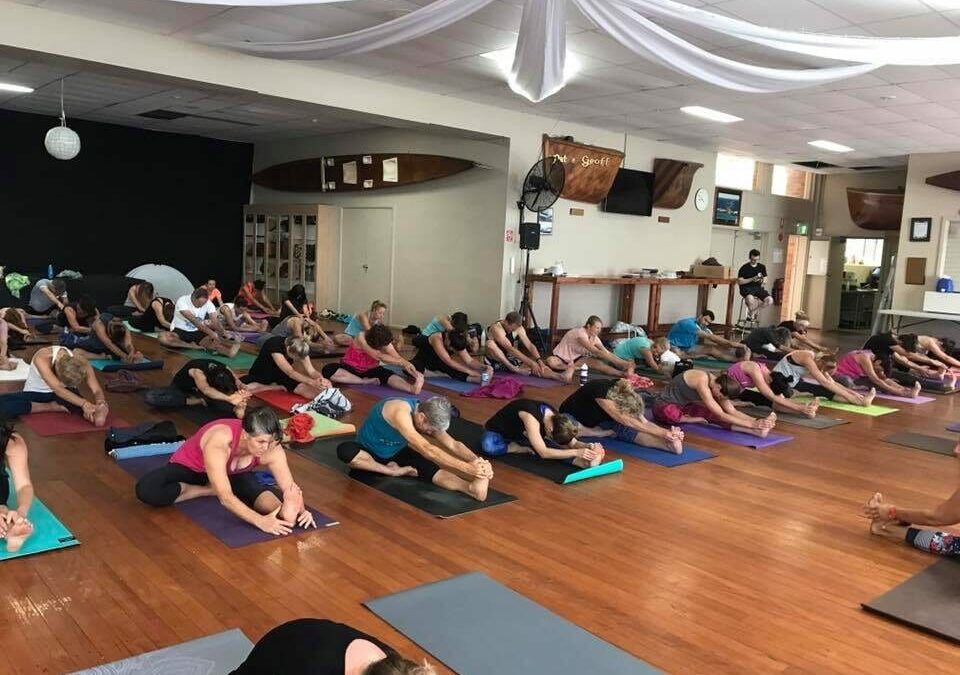
I’m part of a yoga teachers practice group which meets monthly. We get together for a led-practice and then breakfast afterwards.
It’s a mutual gathering. No one person is the boss of it. The person leading and venue of the group rotates each month. This is semi-rural Australia, so we teachers come from all over. Some have to travel 1.5 hours to attend.
Besides enjoying the benefits of learning from each other, we get to float questions. For instance, last Saturday we were talking about how some teachers present their yoga classes off-the-cuff. […]

by Eve Grzybowski | Nov 5, 2017 | Community, XCommunity
Pop Up Yoga
Pop Up Yoga is the sort of yoga that might turn up in your local park or at the beach, especially as the weather warms up in Australia.
I went to a pop up kind of event at Flynn’s Beach, Port Macquarie, this morning. It was partly organised by the Yoga Shala and partly by the Coastal Warriors. Seventy-five people attended and funds were raised for the Coastal Warriors. They are a dedicated group of volunteers who clean up the local waterways. […]
by Eve Grzybowski | Feb 20, 2017 | Yoga Sutras of Patanjali, Philosophy, Wisdom
Why bother with principles and foundations?
This week, I’m teaching a module on principles and foundations of yoga to trainee teachers. It sounds like a big topic, so where to start?
Of course, The Internet! I googled the above terms to see what was out there. Not so much, it would seem. Then, I wondered about the definitions of the terms.
Finally, I thought, why are we bothering anyway with these subjects in a teacher training? Thirty-seven years ago, it wasn’t part of my training.
Well, it should have been. […]
by Eve Grzybowski | Apr 27, 2014 | Health, Video, XToolKit
via pinterest
Every now and then, I fall off the wagon. I recognise that I need to re-incorporate corpse pose into my yoga practice. Writing a post about this pose will inspire me, and you too, if need be.
I first learned about corpse pose (savasana) from one of my yoga teachers, Martyn Jackson. As Martyn explained it, corpse pose isn’t meant to be in any way considered a morbid notion. It defines the ultimate state of letting go.
When we do savasana, we may rise from the pose feeling we’ve slept the sleep of the dead. […]
![Yoga Lesson Plans: Surrender to Adapting]()
by Eve Grzybowski | Jun 21, 2013 | Pleasure
Many yoga practitioners spurn watching television and some don’t even like reading the newspapers. In the spirit of full disclosure, I’ll just say that I’m not one of them. In fact, I watch a lot of programming. I am discerning. My interest in good programming started way back with a couple of brilliant shows called, “The West Wing” and “The Sopranos”*.
I felt sad last night when I heard that James Gandolfini, the star of the “The Sopranos” had passed away. […]
by Eve Grzybowski | Apr 24, 2013 | Gardening, Healing, Health, Yoga practices, Yoga teaching , Yoga Therapy
Out of all the thousands of poses in the world, how do you know which of them to practice.
Or, if you’re a yoga teacher, how do you know what to teach?
Of course, it depends on many of variables, the most important one being, read your body. Another indicator is read the seasons.
At the moment we’ve been doing summer gardening – especially cutting back weeds and hauling full wheelbarrows of them for disposal. […]
by Eve Grzybowski | Jan 10, 2013 | Philosophy, Wisdom, XSutras, xTmp, Yoga practices, Yoga Sutras of Patanjali
I wish, as a yoga teacher, I had more sway with my students in encouraging them to do their own practice. It’s not that I want them to disappear from the classes I teach. […]
by Eve Grzybowski | Sep 21, 2012 | Philosophy, Wisdom, XSutras, xTmp, Yoga practices, Yoga Sutras of Patanjali, Yoga teaching
Source: awakenedlotus.tumblr.com via Tara on Pinterest
Have you ever done a ten-day Vipassana course? I attended a couple of these meditation retreats, which are conducted completely in silence, in the 1980’s.
I didn’t think that the sitting/walking meditations would be challenging for me because I’d been doing yoga and therefore wouldn’t experience much bodily discomfort.
It’s true that I didn’t suffer as much as some people did from the hour-long sitting sessions. What I wasn’t expecting though was that, when the meditation room was quiet and my body was motionless, my mind would go into overdrive. […]
by Eve Grzybowski | Aug 28, 2012 | Philosophy, Wisdom, XSutras, xTmp, Yoga practices, Yoga Sutras of Patanjali
Source: images.google.com via Valerie on Pinterest
I’ve been interested in the big picture of yoga for many years. I’m talking about the way the system of yoga thoroughly considers all aspects of a person – you could say, human and even divine.
Tree of yoga is how the structure is described in that it is comprised of eight limbs, listed below.
As a budding yogini, in my twenties, I was only interested in the third limb – asana – the practice of postures. […]
by Eve Grzybowski | Jul 31, 2012 | Nature, Philosophy, XSutras, xTmp, Yoga practices, Yoga Sutras of Patanjali
Source: piccsy.com via Marianne on Pinterest
I should have had a little birthday party for “Yoga Suits Her” last week, as I completed my 700th blog post. Woo-hoo! I can hardly believe it myself that I have been this regular for so long. There was even an earlier incarnation in my blogging career called “The Ville” where I cut my teeth.
I want to share what I’ve learned through my writing and especially in this latest endeavour of Yoga Sutra study.
It’s okay to write vulnerably. […]
by Eve Grzybowski | Jul 18, 2012 | City Life, Gardening, Nature, XSutras, xTmp, Yoga Sutras of Patanjali, Yoga teaching
Source: flickr.com via Katherine on Pinterest
Did you enjoy a gloriously sunny winter day today? I did. It called to me to get into the garden and weed and plant.
I’m a metropolitan girl from places like Chicago, New York and Sydney. Gardening is not my first language. What does that matter, though, when Nature calls?
There’s rocket, lettuce and dill in the dirt now. I’ve checked the weather report and it will be cold over the next few days but not frosty. […]
![Yoga Lesson Plans: Surrender to Adapting]()
by Eve Grzybowski | Jul 17, 2012 | Philosophy, Wisdom, XSutras, Yoga practices, Yoga Sutras of Patanjali, Yoga teaching
If you’re a yoga teacher, have your yoga classes been suffering the winter blahs. It’s common during the Australian winter that class sizes can decrease and even become minuscule.
In one of the sessions I teach, the numbers attending have dropped right off for a variety of reasons: school holidays, winter flues and colds, sprained ankles or broken arms, work conflicts – all the usual stuff.
I think I’m way beyond taking this lack of students personally. […]