Tag Archives: yoga practices

A Yoga Sutra a Day: I:28 Sacred Cows

The calves have started popping out of Farmer Scott’s beef cows on the property next door to us. I haven’t actually seen any births but the numbers of these labrador-sized creatures are increasing each day. They are an amusing combination of boofy and frisky in their behaviour; it’s easy to lose track of time watching calves and mothers do very little but lick and suck.

Calf Time

The cows reminded me of a story that relates to Chapter I of Patanjali’s Sutra which I have been attempting to unravel with the help of some wise interpreters over the last month or so. It goes like this:

Two sages visited an ashram to attend satsang. They found their seats right in front of the guru. The space filled with other attendees and the evening discussion on the yoga practices of asanas and pranayama began.

The sages interrupted the guru to say, “We’ve come to discuss more important things, like the philosophical implications of samadhi according to Patanjali.” But the two failed to agree with each other and began quoting from various scriptures to prove their separate points of view. Soon they were having a boisterous argument, and even the guru couldn’t get a word in.

Eventually the two sages came to blows, but the guru remained silent, even as the argument continued for some time.

Then, a big, fat, contented cow wandered in as though she owned the ashram, which caused some hilarity among the group – except for the humourless sages whose intellectual debate made them oblivious to their surroundings.

Suddenly the cow began bellowing: “M-o-o-o-o-o-o-o-o-o-o.” The sages jumped with fright and were completely at a loss for words. Everyone laughed and the cow lumbered away, perhaps to find a more stimulating sat sang.

Perhaps the cow’s visit was a wake-up call, a reminder that the Sutra are not meant to be studied as intellectual exercises but rather to give practical methods for raising awareness.

The repetition of the sound AUM is such a method for gaining deeper wisdom.

tajjapah tadarthabhavanam

The mantra aim is to be repeated constantly, with feeling, realising its full significance.*

*Light on the Yoga Sutras of Patanjali, B.K.S. Iyengar

(you may need to refresh the screen to view the video)


Hard & Soft Yoga


Up Dog

Today I visited and participated in a Satyananda style class led by the director of Yoga Directions in Taree, Peppa.  The dreads-coifed Peppa is something of a local household word – that is, if the conversations in your home run to yoga.

The 15 or so attendees in this morning’s session were all females, ranging in age from upper 20′s to upper 60′s. We did a variety of yoga practices: asanas, pranayama, and meditation, and the mood that Peppa instilled was “chill”.

When I was a strict Iyenar-ite, I snubbed my nose at what I deemed the soft yoga  styles – the sort of methods which set out few physical challenges for me.

Older and wiser now (or, at least I like to think I am), I see plenty of challenge in being able to stop, relax, and breathe. These three acts reflect the practices of meditation, pratyahara, and pranayama.

Instead of pushing myself to attain the quintessential poses, I’m paring back asanas, deconstructing them, if you will, to find the essence of them – the place where I am strong, stable, and, most importantly, comfortable in each posture.

My early days of yoga were in the No Pain, No Gain era, but now I’m trying to arrive at what Judith Lasater calls No Pain, No Pain.

Did I like the Satyananda class? Yes, I did. I enjoyed being in the hands of a veteran. I felt subtle energies moving within me as I practiced quietly and calmly. And, I made a valuable connection with a colleague who has kindly agreed to promote the sales of our YogaAnywhere cards.


Does Yoga Help You Lose Weight?

Pink

I wish I could answer that question. Really. Even more, I wish I could answer in the affirmative.

I haven’t seen evidence that the claims of weight loss directly due to yoga practice is true. In fact, I know quite a few long-term yoga instructors who have stacked on weight as they get older. That’s not necessarily a bad thing, except when there are health issues.

Losing weight, as you know, typically occurs when the food and drink you consume is more than your caloric expenditure.

Many yoga practices use up less energy than traditional exercise, like gym workouts and stress sports. So, if you want to make yoga practice burn calories the way gym activity does, choose a vigorous style that gets your heart rate up.

One way that yoga can help is when it increases mindfulness and sensitivity to your bodily needs. You then naturally want to make healthy food choices, control the amount you eat, and have your meals in a relaxed setting at a leisurely pace.

Yoga can support you in reducing stress, which creates the space for more calm and thoughtful food choices and eating. You eat when hungry, rather than because it’s the regular time to eat, and you choose to stop eating when you are satisfied, rather than over full.

When it comes right down to it, yoga is more than physical practice. It is meant to offer a healthy lifestyle comprising a moderate diet, wholesome attitudes, clear moral choices and philosophic study.

As you become more deeply involved in yoga practice, you are more centred. You embrace an attitude of compassion toward yourself and others, are less influenced by cultural norms, and are more established in your inner values.

Then, losing or gaining weight will be a non-issue. What matters is the relationship you realise with your intrinsic Self.


Looking at Yoga Practice – “Through the Keyhole”

Near the end of last year, I was out in the Yoga Shed, all by my lonesome, practising yoga, and my mind drifted. (I think I was doing supta baddha konasana or some such very relaxing pose.)

I was thinking about what other people might be doing in their yoga practices these days – old cronies of mine, like Peter Thomson, Pixie Lillas, Shandor Remete. Did they still do a mainly asana-based practice? Or, had they adopted more of a pranayama/meditation orientation? I thought, wouldn’t it be interesting to be able to look through a keyhole and see what people were doing in the private of their yoga practice that might be interesting, inspiring, surprising….

That day, I called up Colin Clements from Australian Yoga Life magazine and suggested a column called “Through the Keyhole”, which would feature interviews with practitioners describing their yoga practices. The contributors could be yoga teachers, beginners just learning to do home practice, or experienced students willing to share struggles they might have with their practice. And, they might come from any tradition or style of yoga.

With this March-May issue of the magazine, my suggestion has been launched. And, Colin has kindly let my own interview introduce what I hope will be a popular series.

Here’s a little excerpt…when I was asked, “Why do you practice?”

It’s partly a habit. It’s my path to being the person who I am intrinsically….

[Yoga] helps me be true to myself in the real world (off the mat), and that becomes a habit by itself, the habit of being me.

Please have a look at Issue 34, not just for my piece, but also for all the great encouragement that that the articles of Australian Yoga Life provide.

AYLCover

Yoga & Hip Replacement Surgery

Hip surgery is a daunting prospect for anyone. The first suggestion of the surgical option usually comes well in advance of the need for the actual operation. But it’s a red flag that starts to shape one’s thinking towards the inevitable, especially when levels of pain and physical limitations are increasing.

If you are someone interested in more natural ways, of dealing with health issues, then surgical intervention can seem scary in the extreme. Now that I am on the other side of double hip surgery, I can say that because of a wonderful surgeon and brilliant technology, I have my life back.

For yoga practitioners who are hip sufferers, there are some sacrifices to be made before your life will become all sunshine and roses again.In the last period before your surgery, you may be in quite a lot of discomfort, have developed a limp, and needed to change your lifestyle accordingly. Poses that you performed with ease, may not be accessible and if your practice was strong, you may have to adopt gentler and more reflective yoga practices. This takes a good deal of humility and a dedication to loving self-care.

If you are an independent person, you will need to become more reliant on others, both before and for a good while after the surgery. That’s just a given. This was so hard for me, and one of the most transformative “gifts” from the experience.

When researching the type of surgery I would have and the kind of prostheses I would receive, I realised I had no idea what was best. The amount of information on the Internet can feel overwhelming. I trusted the surgeon I chose (after seeing three different ones) and decided I would take my surgeon’s advice. Really, they are the ones with all the experience.

I had posterior incisions with ceramic and titanium devices. I was told that they would give me strength and durability. I am limited in some of the range of movement I used to have, but for a hyper-mobile body type, this probably makes my hips stronger and more stable. Most yoga students need to be working on strength and stability instead of ultra-flexability, so my hip surgery experience has helped me help them more.

I got back to teaching yoga four months post-surgery, taking it slowly to recover and rehabilitate. I feel I am still going from strength to strength.

The expense of the operation and rehab is considerable and it is necessary to take considerable time off physical work for full recovery, but all of it is an investment in your future. Not something that can be stinted on in any way.

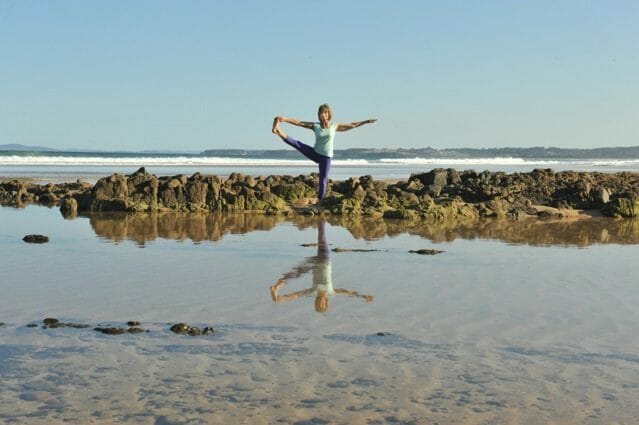
Here’s an image a year after my replacement surgery, pain-free, having re-gained much movement and suppleness.

 All changes, even the most longed for, have their melancholy; for what we leave behind us is a part of ourselves; we must die to one life before we can enter another.
Anatole France