I heard a friend say today that she is happy this year is almost over and that next year has got to be better. Then, she added, ‘That’s what I said the year before, though.’ In my opinion, last year and the year before were not bad. This period forced upon me the realisation that I am not really in control. And that uncertainty is the only bedrock that we have and all our machinations will never change that fact.
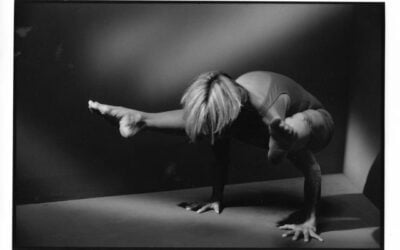
Where do people get their ideas? Often through social media. These days, Instagram and Facebook carry much responsibility for publishing impossibly beautiful and youthful images of people doing yoga. Discouraging to anyone who is trepidatious about taking up yoga in the first place.
Time doesn’t quite fly always. Sometimes it does. Sometimes it plods. I know it’s forty years of teaching yoga because I can add up the students I’ve taught along the way. It’s a lot!
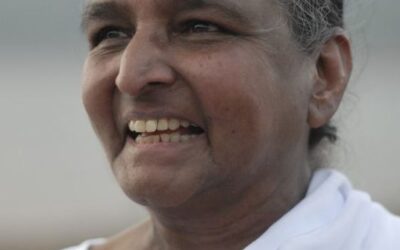
I always felt that Gita lived the life of a nun. She dressed in white and was steeped in the wisdom of spiritual texts. Gita devoted herself utterly and completely to the needs of her father and brother after her mother’s death. She worked tirelessly to ‘reveal’ yoga to the world, travelling and teaching, even as her health was failing.
When I started teaching, my first classes were not altogether successful in terms of bums-on-mats. It took tremendous staying power in the beginning to keep coming back week after week to small classes when I wasn’t making a living. One has to continuously calm the negative mind and recreate motivation for practising and teaching. Who knows if or when one is going to make a go of it? How long will it take to be a good teacher? How long will it take to ‘be yoga’?
I’ve been invited to teach at a very special festival at the end of the year called Shambala–Lost Paradise.
Now that I’ve accepted the invitation, I’m wondering what it will be like. From the description below, it sounds like so much more than a yoga festival experience. Here’s how Lost Paradise advertises itself, incorporating some of these elements:
A Hidden Wonderland…Dancing under the Stars. Nurture by Nature. Sparkling Conversations by Water. Yoga in Full Flow. Acoustic Sessions. Inspirational talks. Pop-up Performances. Twinkling Pathways. Rejuvenating Massage. Disco Yurts. Twilight Parades. Electronic Alcoves. Sumptuous Feasts. Four-Poster Day-Beds. Late Night Speakeasys. […]
Why we don’t make up our own quotable quips? Why do we rely on celebrity or guru quotes, which are sometimes misquotes or misattributed)?
Yoga teachers-in-training tend to spout their teachers’ words exactly when they begin teaching. I still do. My Iyengar teacher from the eighties, Martyn Jackson, pops up in my classroom instructions on occasion. As do more recent influencers, like Donna Farhi or Judith Laseter.
As yoga teachers become more seasoned, they fashion their own phrasing. And then, their quips, quotations and word pictures will undoubtedly plant find their way into the next generation’s repertoire.
It would have been nice to start out in my teaching career as a completely relaxed yoga teacher, but that doesn’t often happen. Perhaps that old line about it taking years to be an overnight success is valid.
Planning and plotting have been long-held habits in all areas of my life. I could also say that they have been expressed as perfectionism. Little by little, though, I have been learning to trust what I know and what I have embodied.
I’m part of a yoga teachers practice group which meets monthly. We get together for a led-practice and then breakfast afterwards.
It’s a mutual gathering. No one person is the boss of it. The person leading and venue of the group rotates each month. This is semi-rural Australia, so we teachers come from all over. Some have to travel 1.5 hours to attend.
Besides enjoying the benefits of learning from each other, we get to float questions. For instance, last Saturday we were talking about how some teachers present their yoga classes off-the-cuff. […]
I will be teaching an afternoon workshop on The Art of Adjustment in Byron Bay Sunday, August 20th, 1-5 pm.
At the risk of punning, I’m an old hand at hands-on adjustments. […]
You can start Yoga at any stage in your life. More importantly though, for your quality of life to improve and discipline become more natural, you can increase your commitment to this most beautiful practice anytime – especially today!
A bright ideaOne thing I thought of earlier this year was getting local yoga teachers together for a once-a-month practice. The idea I had was that we teachers would come together with one individual leading a yoga practice, and that that person would nominate the venue. Well, it’s happened. So far, we’ve met three times with an average of six of us at each practice. It’s been a great success, not the least seeing each others’ yoga studios. We meet early…7:30 am for an hour and a half practice and afterwards go out for breakfast. […]
The Eyes Have It!
A couple of years ago my optometrist discovered that cataracts were forming in both of my eyes. He predicted I would need cataract surgery someday. I was not looking forward to this ambiguous ‘someday’. […]
Finding the Right BalanceThere’s a problem I face when developing a new workshop: I don’t know exactly how much material to put in. Typically, I get excited and create too much. Fortunately I’m experienced enough to calibrate how much I can teach in a workshop as I go along.Still, I get attached to the sequence of poses I’ve created, to having it flow seamlessly and to being able to include interesting variations.I ran into this too-much-material problem when I was teaching a new workshop called ‘Yoga: A Lifelong Companion’ at The Yoga Shed in Richmond, NSW this last weekend. […]
I’ve been away for a couple of weeks, visiting family in the U.S. When I came back to Australia, I went on retreat for 8 days.I want to share with you a few things I learned on this hiatus. These are insights that I might even categorise as spiritual practice.Gifts From My FamilySpending time with my family is sometimes the toughest test of my life commitment to be kind and non-reactive. However, in the company of my family, when I reacted in a non-loving way, this is when I got to practice forgiving myself. […]
‘Be great, none of this humble stuff!’, said friend Heather to me as I trundled off to teach an out-of-town yoga workshop. I can see why she would advise me thus.
I probably come across as not overly ambitious when I teach. I don’t mean to be blasé. I do a lot of planning for any seminars I teach. If anything, I over-plan. When I do that, I end up more worried about my plan than being present to workshop participants. […]
Beginnings and Another Birthday
This blog, ‘Yoga Suits Her’, has a birthday and it’s New Year’s Eve 2009. That makes her five years old.
I think you’ll agree that the expression ‘time flies’ is a truism. But as a septuagenarian, I have to say time gallops. With age, I feel slower, but the tempo of time beats faster. You’ll see!
One thousand eighty posts into ‘Yoga Suits Her’, I can still remember sitting down to write my first one. That old post seems so tentative, almost shy, compared to what I write now. […]
“I can’t believe Eve Grzybowski is 70. She’s a walking advertisement for the benefits of yoga to combat ageing.”
When I read the above Facebook comment, which is obviously meant to be a compliment, I smiled. It brought up images of me in battle gear, all manner of weapons in hand, throwing myself against the cruel onslaught of Time.
Nothing could be further from the truth. My seventy years have shown me that time marches inevitably foreward. Fighting its effects, I’ve noticed, is not only futile but exhausting.
BTW, I don’t do yoga to thwart ageing. […]
I don’t usually study with other yoga teachers and here’s why: I live hours from any major city centre and tend to stay close home. I like doing my own practice in the Yoga Shed. And, well, okay, I’m a bit of a snob. I want to study with the best when I take time to travel long distance and spend time with a teacher.
Recently, when the opportunity to study with Donna Farhi arose, I leapt at it.
She and I go back. […]
This last weekend, I had the privilege of teaching a group of yoga teachers and keen students in a workshop entitled “The Art of Adjusting.” In the lunch break I spoke to one of the participants about her concern that her classes seem to stay small, even though she’s been teaching them for some time.
What do we mean when we say a small class? These days classes can have fifty students in them, or more. […]