Category Archives: anatomy

Yoga: When the Phone is Ringing, It Helps You Connect

Rehab

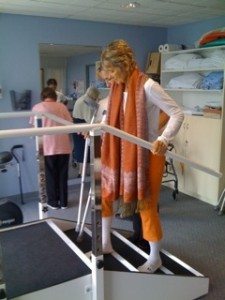
Judy is in a rehabilitation centre at the moment ‘finding her legs’, as she is 15 days out from double hip replacement surgery. She is a veteran yogi and also trained as a yoga teacher, and probably has about 35 years of Iyengar yoga under her belt.

Judy’s doing another kind of training now with the physiotherapists at Hunters Hill Private Hospital. These stalwart practitioners run the residential patients through their paces and are both caring and strict – tough love, you could call it.

I was in the same facility as Judy over 3 years ago, and I noticed how much difficulty the majority of patients had doing their exercise routines. It wasn’t simply the problem of learning to walk again with a new knee or hip. It was more basic than that. Many of these people couldn’t connect with their bodies to make them do what was expected of them.

Imagine the phone is ringing and not being able to find it to answer. The physios would give the patient an instruction and he or she couldn’t understand or might misunderstand what was required – making re-training the muscles a long and tiring process. Some people gave the routines only a half-hearted attempt, just to please the physios, and their exercises became less effective.

Sometimes we take for granted the benefits we get from yoga: an upright posture which helps us to breathe properly; attention to breath which helps create optimum energy; and, a sensitive awareness that lets us connect the mind with the breath and the body.

When we are well we may not fully appreciate our good health, and that’s human nature. It’s when we are coming back from illness, injury or surgery that we can take advance of the investment we’ve made in our regular yoga practice.

Share via email
Submit to StumbleUponSubmit to reddit

Side Wise

Source: etsy.com via Alison on Pinterest


This week I came up with a sequence I enjoy doing and teaching. The theme is all about stretching the sides of your body, particularly hips, waist, rib cage, shoulder blades and arms.

Somewhere along my yoga travels, I heard an expression that I like: ” the sides of our bodies are the lonely parts”. I get that. If you think of all the ways a body can move – bending forward, backward, rotating – then, sideways bends are most unfamiliar movements. I think that one of the reasons that trikonasana and parsvakonasana are such a popular poses is because we get to exercise our  lateral bending.

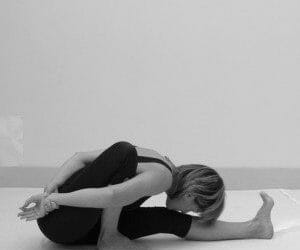
Here’s the ‘goal’ pose of my sequence, parivrtta janu sirsasana (revolved head-to-knee pose):


Near to the end of your yoga practice, when you’re properly warmed up, it’s a great thing to first do this pose on each side, and then do it again and hold longer on the second round. That’s when you surrender more, and feel the increased space of the inner organs: liver, gall bladder, stomach, spleen and, of course, lungs.

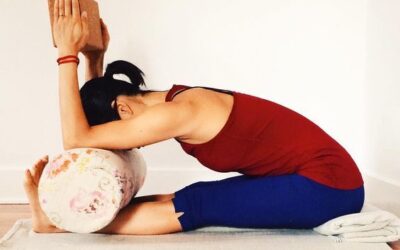
At the finish of your session just before savasana, try this. Sit on the floor with your legs straight out and together. Bend forward into paschimottanasana (double-leg forward stretch) and hold wherever you can…hands on shins or holding your feet. After stretching up and out, bring your extension into the sides of your waist and ribs. Then, take the stretch into the outside of your shoulder blades, upper arms and elbows, even bending them. See how much your side body helps increase your forward momentum. It feels good, like an itch that has been scratched….And maybe even not so lonely anymore.

Share via email
Submit to StumbleUponSubmit to reddit

Hips Are All the Rage

Baddha Konasana

Is there an epidemic of hip replacements going on? I know of three yoginis who will have the surgery done within a month time frame – mid-March to mid-April. To be fair, I also know women who haven’t done yoga who, for various reasons, had to have replacements.

If you’ve been following this blog, you know my story of bi-lateral surgery, performed more than 3 years ago. I had osteoarthritis for 18 years before finally having the surgery, and since the operation I’m a new woman.

I would say of my own history that participation in high impact sports was a big contributor to degeneration in my hips. Yoga actually was my main healing modality in the leading up to the surgery and in months of rehabilitation afterwards.

The strange thing that happens when life serves up a calamitous situation, i.e., arthritic hips for a yoga teacher, is that it’s an opportunity to glean whatever lessons there are to learn. Then there will be ample chances to share your experience with others facing similar problems.

Here are some more articles on the topic:

Yoga and Hip Replacement Surgery

Letter to Arthritis Hip Sufferers

Burdened By Weight


Share via email
Submit to StumbleUponSubmit to reddit

A Sutra a Day: III-31 – Bridge to Serenity

Source: katsaksyoga.com via Eve on Pinterest


In the backbend ‘family of poses’, Setu Bandha Sarvangasana (Bridge Pose)  has been dubbed ‘a boon to mankind’ by the yoga master B.K.S. Iyengar. Apart from its capacity to wake up the senses, Setu Bandha strengthens the legs and hips, massages the spine, and opens the heart.

Holding this pose offers an opportunity to explore the body and its movements with attention and care. Along the way, the mind is calmed and the body becomes energised, leaving the practitioner feeling revitalised and refreshed.

For those who spend long hours stooped over their desk work and working on computers, the pose is an effective antidote to an overly kyphotic spine (dowager’s hump).

In the above image from Light on Yoga, Mr. Iyengar is actively performing the posture. But the beauty of Setu Bandhasana is that it can be done in a variety of ways using props, each version producing slightly different salutary effects.

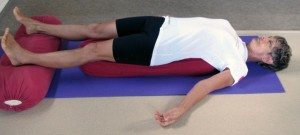
Here’s a lovely ‘soft’ approach to the pose that uses props. Stay for 5 or 10 minutes just feeling your breath in the mid-sternum.

Setubandhasana

Kurmanadyam sthairyam

Samyama on the chest area and enquiry into the sensations felt there in different physical and mental states gives one the means to remain stable and calm even in very stressful situations.*

*Patanjali’s Yogasutras, translation and commentary by T.K.V. Desikachar.

Share via email
Submit to StumbleUponSubmit to reddit

A Sutra a Day: II-47 – Relaxed Effort


I’ve always been intrigued by the human body and wanted to learn about it. Recently, I’ve been enjoying studying an anatomy and physiology course again. This is the 3rd one I’ve done over the years, but the first time on-line.

We’re so fortunate these days to be able to study with video lectures, monographs, articles, textbooks, and so on – no farther away than a click of a mouse. Much better than sitting in draughty lecture halls with sometimes boring tutors.

I’ve been fascinated by the physical demonstrations from the Applied Anatomy and Physiology with Simon Borg-Olivier of Yoga Synergy, because he appears to have such complete and easy command of his body. He can isolate muscles to show minute movements of joints or put himself into yoga postures to explain how his anatomy principles create best practices.

Simon seems to have a good grasp of Sutra II-47, in the way that commentator B.K.S. Iyengar sets it out:

The sadhaka (a person on the yoga path) can be considered firm in his postures when persevering effort is no longer needed. In this stability, he grasps the physiology of each asana and penetrates within, reaching the minutest parts of the body. Then he gains the art of relaxation, maintaining the firmness and extension of the body and consciousness. In this way he develops a sensitive mind. With this sensitivity, he trains his thinking faculty to ready, study and penetrate the infinite.

Prayatna-saithilya-ananta samapattibhyam

Perfection in an asana is achieved when the effort to perform it becomes effortless and the infinite being within is reached.*

*Light on the Yoga Sutras of Patanjali, B.K.S. Iyengar.

Share via email
Submit to StumbleUponSubmit to reddit

A Sutra a Day: II-33 – Turn Complaining on its Head!

I ached to go to the beach today. But I didn’t allow myself. It’s Monday and I had a number of tasks to do:

  1. Yoga practice
  2. Clean house/clean yoga studio
  3. Write post for www.yogaanywhere.net
  4. Post to Facebook YogaAnywhere x 2
  5. Send posts to social media
  6. Pack orders of YogaAnywhere cards for posting
  7. View week 3 video for on-line anatomy and physiology course
  8. Continue painting project for studio
  9. Prepare content for evening class and teach it
See, no time.
I’ve been complaining about all the things I have to do until I got sick of listening to myself. Now, I’ve broken the back of my long list by just by shutting up and doing them.
It’s about choice. Yoga is about remembering that.
Tomorrow – sunny and 24 degrees – and going for a walk on the beach is back on my list.

vitarkabadhane pratipaksabhavanam

Unwholesome thoughts can be neutralised by cultivating wholesome ones.*

*The Yoga Sutra of Patanjali, a new translation with commentary by Chip Hartranft.

Share via email
Submit to StumbleUponSubmit to reddit

A Sutra a Day: II-23 – Teacher Training, It Never Ends


I had breakfast with one of the delightful yoga students whom I’ve met since relocating to the country.

I was afraid that when I left my yoga teaching business of 30 years in Sydney that I wouldn’t develop inspiring relationships in my new locale. By inspiring, I mean that students inspire me as much as the reverse.

This particular lass has been in love with yoga for a long time and is now considering doing teacher training. Just in case there are some of you readers who have thought about training, I’m going to post my advice to my young student here for you to read, too.

There are many good trainings to avail yourself of right ’round the world. It just depends on how much time and money you want to invest, and what sort of yoga suits you temperamentally.

In Australia, I have experience with the Byron Bay Yoga Centre where I have taught as part of their Yoga Therapy faculty for four years. This centre presents their trainings at various levels and in different formats. You can do your training in Sydney, Melbourne, Bali and New Zealand. The fast-track intensives on offer mean you’ll take minimum time away from your work and/or family.

If you are interested in the B.K.S. Iyengar method, you will be up for a rigorous and lengthy training. You will have had to commit to one teacher, and studied with her or him for some time. Then, if you are deemed a sincere candidate, your training will comprise a couple of years study, plus a year of apprenticeship, before undergoing an assessment for a grading.

In Sydney, Qi Yoga on the northern beaches runs a year-long program. Their course is nationally registered with Yoga Australia and gives a qualification as a “Level 1 Yoga Teacher”. Nature Care College, where I taught for 9 years, offers a year-long weekend program that awards a Diploma of Yoga Teaching upon successful completion of the course. Check out Sindar Kaur on video on Nature Care’s site talking about the training.

I did my original yoga teacher training in 1980, then apprenticed to my teacher for a few years afterwards. I added to my qualifications in 2000 in a training I did over a two-year period. At the moment, I’m studying in Simon Borg-Olivier and Bianca Machless’s on-line Applied Anatomy and Physiology course. I’ve lost track of the number of A & P courses I’ve done; it never ends!

If I were to start all over again and I could study anywhere, I would choose from the two courses below. Why? Because both courses lead to the fulfilment of Patanjali’s aphorism of today (below), which describes the point of the practice of yoga.

1) The Yoga Institute, located on the north shore of Sydney. The caliber of the teachers and the curriculum is superb, and the school offers three course structures for maximum flexibility.

2) The Yoga Room, in Berkeley, California. This is a course that comprises the Iyengar style, which is still where my heart is. The faculty are seasoned and dedicated yogis with decades of experience and wisdom.

There are countless wonderful trainings around and I hope I haven’t offended anyone by giving just these few the spotlight. If you are partial to a certain yoga teacher training, please let me know.

Sva swami saktyoh svarupopalabdhi hetuh samyogah

The conjunction of the seer with the seen is for the seer to discover his own true nature.*

*Light on the Yoga Sutras of Patanjali, B.K.S. Iyengar.

Share via email
Submit to StumbleUponSubmit to reddit

These Old Bones

Last night I slept on a thin futon on our friend’s floor. Their apartment is small; Daniel got the couch.

During the night, I started to experience my first hip pain since having the replacement more than two years ago. Not arthritic pain, just bony bits meeting too firm a surface. Ouch.

The ache in the hip went on for most of this morning till I could finally adopt a few yoga moves. Walking some distance lubricated the machinery, so I’m in good nick again.

Moral of the story: I’m too advanced in years and too skinny for floor surfing. Blow up mattress, more salubrious lodging or I get the couch next time!
Sent from my iPhone

Share via email
Submit to StumbleUponSubmit to reddit

Yoga and Body Rhythms

Fragrance

I was just heading to bed, my body not quite knowing what the “real” time is since we have just gone off daylight savings last night.

Of course, I know the real time. The clocks have been set back. Now I just tell my body clock what to do, so we’ll go to bed “early” to comply with the new time.

Isn’t it funny, odd, that we can disassociate from our bodies and just order them around like they were our servants? That must explain how labourers can work 8, 10, 12 hours a day doing manual toil and still be able to get up the next day and do it all again.

What about “the body is my temple”?

When you strike a pose in a yoga class, are you flogging your body by trying to make it do more or better? Do you go to the other extreme, being ultra cautious, because you had a difficult time in a posture in the past? Or, do you dance with a pose, listening to your body’s rhythms, and allowing them to lead? Do you take your own sweet time in getting into and out of poses to savour the moment and notice what’s happening?

It takes courage and discipline to pay attention right now and show up with sensitivity and respect for your body – time after time. The reward is that you feel in tune and integrated.

Our own physical body possesses a wisdom which we who inhabit the body lack.  We give it orders which make no sense.  ~Henry Miller


Share via email
Submit to StumbleUponSubmit to reddit

Sequences for “Intensive” Week: Day 3

Like the family of poses called inversions, back bending poses can elicit a love-hate relationship with yoga practitioners. This fact sparked a post I wrote a while back called “Befriending Backbends”.

My intention for the sequence I’m going to teach tomorrow is to introduce a little anatomy, do some warm-ups that include passive backbends, followed by the more classic backbends.

Here’s a few basic points for the “simple backbends” you do lying in the prone position:

  1. Make sure you use your deep neck flexors to lift your head.
  2. Hollow your abdomen as you lift up, but keep your bottom ribs on the floor.
  3. Squeeze your thighs lightly.
  4. Keep your buttocks firm but not clenched.
  5. Use your mid-back muscles to strengthen your shoulder blades.
  6. Keep your shoulder blades down toward your waist.
  7. Move your groins away from your kidneys and your kidneys toward your head.
  8. Most of all, don’t be pushy.
Warm-up:
Lying down, block pose
Lying down, urdhva hastasana
Pelvic lifts
Standing, urdhva hastasana
Garudasana
Dynamic:
Adho mukha svanasana
Step-back lunges
Tadasana
Parsvakonasana
Virabhadrasana 1
Trikonasana
Ardha Chandrasana
Prasarita Padottanasana
Preparation for Pincha Mayurasana
Salabhasana
Bhujangasana
Dhanurasana
Urdhva Dhanurasana
Parsva Uttanasana
Setubandhasana
Sarvangasana
Halasana
Marichyasana 3
Janu Sirsasana
Savasana
Sitting
Salabasana
Here’s a home practice question which comes from a yoga teacher:
Would you suggest to plan my daily practice ahead and/or keeping a practice journal? I seem to resist that because I believe I then would tend to mentally hold onto thoughts which were just arising for the moment/the day… and that might distance me from what I really need to see/feel in the given moment. But then, on the other side I am afraid to possibly stagnate with certain asanas, meditation  and my pranayama exercises (which probably repeat themself if I won’t review them).
From Eve: What I like to do is think about what I want to teach over a week period. I write it up as a lesson plan, sort of like the above sequence, just broad brush strokes. Then, this will be my practice for each day, and as I do it myself, on repetition it becomes something I can teach “out of my bones”. I tweak the plan according to the level I’m teaching and to the “mood” of each class.
Recently I thought I might need some fresh input because there is always  that possibility of stagnation, so I picked up BKS Iyengar’s Light On Yoga. The appendix has more programs than one would be able to do in several years.
Share via email
Submit to StumbleUponSubmit to reddit